
Shaker vs Slab Cabinets: Best Choice for Palm Beach Kitchens - 2026

Updated: Mar 31
The Cabinet Style Decision That Defines Your Kitchen
You're standing in your dream Palm Beach kitchen, envisioning every detail. The countertops gleam. The hardware catches the light just right. The lighting creates the perfect ambiance.
Everything is falling into place.
Then comes the decision that stops you cold: the cabinet style. Shaker or slab?
It's not just a design choice. It's the decision that will define your kitchen's entire personality for years to come. And in Palm Beach, where every detail matters, getting it right feels essential.
"Your cabinet style isn't just about how your kitchen looks today. It's about how it will feel every morning, how it will handle family chaos, and how it will impress potential buyers when you're ready to sell. That’s why choosing quality kitchen cabinets in Palm Beach starts with understanding your style."
This guide provides a comprehensive, side-by-side comparison of Shaker and slab cabinet styles, analyzing their design aesthetics, cost structures, durability in our coastal climate, and resale value impact. We'll empower you to make the confident choice that aligns with your home's architecture, your lifestyle, and your long-term investment goals.
The Palm Beach Lens: Why This Decision Matters Here
Factor | Why It Matters |
Architectural Diversity | Palm Beach homes span Mediterranean Revival, Coastal Contemporary, Modern Minimalist, and Classic Traditional |
Climate Considerations | Humidity, cleaning ease, and hardware durability vary by style |
Luxury Expectations | Discerning buyers recognize and reward premium design choices |
Resale Value | Cabinet style significantly influences perceived value in our market |
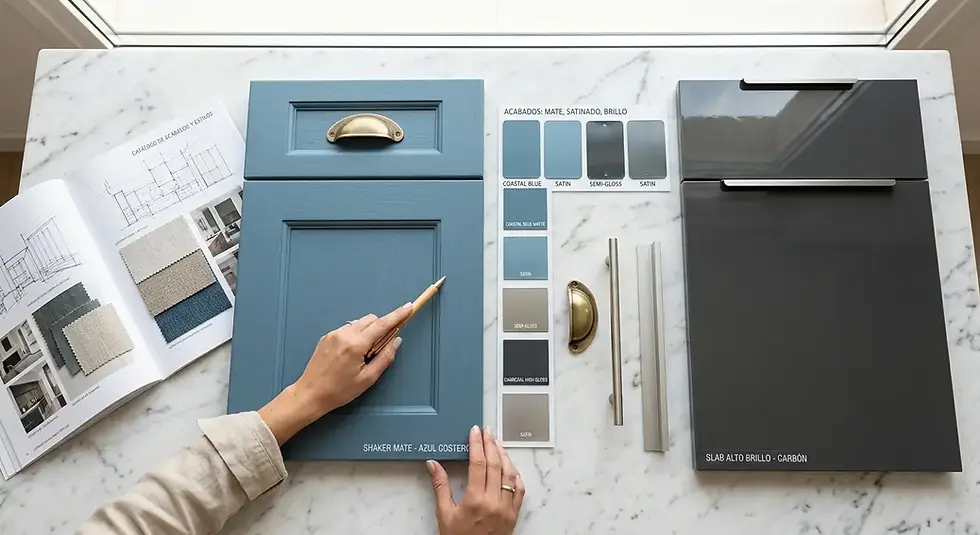
What Are Shaker and Slab Cabinets? Understanding the Contenders
Shaker Cabinets: The Timeless Classic
Origin and Heritage:
Born from the Shaker religious community in the 18th century, these cabinets embody their philosophy of "beauty through simplicity" and honest craftsmanship. What started as humble furniture for communal living has become the most enduring cabinet style in American design.
Key Design Elements:
Five-piece construction: Four frame pieces (rails and stiles) surround a recessed center panel
Simple, clean lines with a distinct frame around the panel
Frame width typically 2–2.5 inches (trending slimmer in 2026 designs)
Versatile , works equally well with traditional and contemporary elements
Why It Endures:
The Shaker style has remained popular for over 200 years because it's neither too ornate nor too stark. It's the perfect middle ground, classic enough to feel timeless, simple enough to feel fresh.
Slab Cabinets: The Modern Minimalist
Definition and Evolution:
Also called "flat-panel" or "European-style" cabinets, slab doors are a single, flat piece of material with no frame or recessed panel. They represent the pinnacle of minimalist design.
Key Design Elements:
One-piece construction: no frame, no raised or recessed details
Completely flat, uninterrupted surface
Often paired with concealed hinges and integrated pulls
Showcases material texture and finish without distraction
Why It's Trending:
The clean, uncluttered aesthetic aligns perfectly with contemporary architecture and the growing desire for streamlined, serene spaces. In a world that feels increasingly chaotic, slab cabinets offer visual calm.

Saker vs Slab. Head-to-Head Comparison – How They Stack Up
Feature | Shaker Cabinets | Slab Cabinets | Palm Beach Verdict |
Design Aesthetic | Classic, versatile, warm | Modern, minimalist, sleek | Depends on home architecture |
Construction | Five-piece with recessed panel | Single flat piece | Slab simpler; Shaker more detailed |
Cleaning Ease | Moderate, dust collects in recessed panel | Excellent, smooth surface wipes clean | Slab wins for easy maintenance |
Cost Range (10×10 kitchen) | $5,000–$18,000 | $4,500–$20,000 | Comparable; depends on material |
Durability | Excellent; frame adds structural strength | Good; relies on material quality | Shaker slightly more robust |
Hardware Options | Wide range of knobs and pulls | Best with long bar pulls or integrated | Shaker more versatile |
Style Versatility | Works in traditional, transitional, modern | Best in contemporary, modern | Shaker more flexible |
Resale Value Impact | Broad appeal across buyer types | Appeals to modern design enthusiasts | Shaker has wider market appeal |
Which Cabinet Style Matches Your Palm Beach Home?
Shaker Cabinets: The Chameleon of Kitchen Design
Traditional Palm Beach Estates: Shaker cabinets in warm wood stains (cherry, walnut) with raised panel variations complement Mediterranean and Colonial Revival architecture perfectly. They add instant warmth and credibility.
Coastal Contemporary: White or light grey Shaker cabinets with slim profiles (1.5–2 inch rails) create a fresh, beach-appropriate look. Paired with beadboard accents and nautical hardware, they sing.
Transitional Spaces: Shaker acts as the bridge between old and new, allowing you to mix traditional furniture with modern appliances without a visual clash.
2026 Trend: Slim Shaker , narrower frames (1.5 inches instead of 2.5) for a more updated, refined look. It keeps the classic appeal but feels lighter and more current.
Slab Cabinets: The Statement of Modernity
Contemporary Estates: High-gloss lacquer slab cabinets in bold colors or neutral tones create dramatic, architectural statements. They're the foundation for kitchens that feel like art galleries.
Minimalist Designs: Handle-less slab cabinets with push-to-open mechanisms achieve the ultimate clean aesthetic. No distractions. Just pure form and function.
Showcasing Materials: Slab doors excel at highlighting natural wood veneers, textured laminates, or metallic finishes. When you invest in exotic materials, slab lets them shine.
2026 Trend: Textured slab , wood veneers with visible grain, fluted details, or subtle ribbing that add visual interest while maintaining clean lines. It's slab with soul.

Shaker vs. Slab Cabinets Cost Analysis – Budgeting for Your 2026 Project
Material Cost Comparison
Cabinet Type | Material Grade | Cost per Linear Foot | Typical 10×10 Kitchen |
Shaker (Stock) | Standard materials | $100–$300 | $3,000–$8,000 |
Shaker (Semi-Custom) | Painted wood, veneer | $200–$500 | $6,000–$15,000 |
Shaker (Custom) | Premium woods, finishes | $400–$1,200+ | $12,000–$35,000+ |
Slab (Stock) | Basic laminate | $100–$250 | $3,000–$7,000 |
Slab (Semi-Custom) | High-gloss, textured | $200–$550 | $6,000–$16,000 |
Slab (Custom) | Exotic veneers, lacquer | $450–$1,500+ | $13,000–$40,000+ |
What Drives Cost Differences?
Construction Complexity: Shaker's five-piece construction requires more labor and precision than slab's simple one-piece design. That craftsmanship costs.
Material Choices: Both styles can use the same materials (wood, MDF, veneer, laminate), so material costs are comparable. The difference is in the making.
Finish Quality: High-gloss lacquer slab cabinets often cost more due to labor-intensive application process. Each coat is sanded, polished, perfected.
Hardware: Slab cabinets often require specialized integrated or long bar pulls, which can increase hardware costs. Shaker works with affordable off-the-shelf knobs.
Palm Beach ROI Perspective
Shaker's Advantage: Broadest appeal across buyer demographics. Considered timeless and safe for resale. Real estate agents love it.
Slab's Advantage: Commands premium in modern homes. Increasingly desirable among younger buyers and design-forward purchasers.
2026 Market Insight: Both styles retain value when executed with quality materials. The key is alignment with your home's architecture. A modern slab in a traditional Mediterranean home feels wrong; a Shaker in a glass tower feels dated.

Shaker vs. Slab: Durability and Maintenance – Real-World Performance
Cleaning and Daily Maintenance
Slab: The clear winner for easy maintenance. A simple wipe across the smooth surface removes dust, grease, and fingerprints instantly. No crevices for grime to hide. If you value a kitchen that stays clean with minimal effort, slab is your friend.
Shaker: The recessed panel creates a small groove where dust and cooking residue can accumulate. Requires more detailed cleaning, especially with painted finishes. A soft brush or microfiber cloth in the groove is your best friend.
Durability in Palm Beach Climate
Humidity Impact: Both styles perform equally well when constructed with quality materials (plywood boxes, proper sealing). The material matters more than the style.
Moisture Exposure: Shaker's frame design can create small gaps over time if wood expands and contracts significantly. Slab's monolithic construction eliminates this concern. In coastal homes, this can be a deciding factor.
Hardware Durability: Slab cabinets often rely on push-to-open mechanisms or integrated pulls, which may require occasional adjustment. Shaker accommodates standard hardware that's easily replaceable at any hardware store.
Longevity Expectations
Material | Shaker Lifespan | Slab Lifespan |
Plywood with quality finish | 20–30+ years | 20–30+ years |
MDF with painted finish | 10–15 years | 10–15 years |
Wood veneer | 15–25 years | 15–25 years |

Style Versatility – Adapting to Your Home's Architecture
Shaker Cabinets
Mediterranean Revival: Works beautifully with warm wood stains, arched door variations, and antique hardware. It honors the architecture without competing.
Coastal Contemporary: Crisp white Shaker with slim profiles, beadboard accents, and nautical hardware creates that breezy, beach-appropriate feel.
Classic Traditional: Full-height Shaker with raised panel variations, crown molding, and furniture-style feet delivers the elegance expected in historic homes.
Modern Transitional: Two-tone Shaker (dark lower, light upper) with matte finishes and contemporary hardware bridges the gap between classic and current.
Slab Cabinets
Contemporary Minimalist: High-gloss lacquer in neutral tones, handle-less mechanisms, seamless integration. The kitchen disappears, leaving only space and light.
Industrial Loft: Textured slab (concrete-look laminate), metal accents, open shelving combinations. Urban cool in a suburban setting.
Scandinavian: Light wood veneer slab, integrated pulls, warm neutrals, natural materials. Hygge meets high design.
Art Deco Revival: High-gloss slab in rich jewel tones, brass accents, geometric patterns. Glamour with restraint.
Shaker and Slab Cabinets Pros and Cons – The Honest Assessment
Shaker Cabinets: Pros
✓ Timeless appeal that never goes out of style
✓ Works with traditional, transitional, and modern design
✓ Accommodates wide range of hardware styles
✓ Can be painted, stained, or glazed for endless looks
✓ Broadest resale appeal across buyer demographics
✓ Available at every price point
Shaker Cabinets: Cons
✗ Recessed panel collects dust and grease
✗ More detailed cleaning required
✗ Five-piece construction adds to cost
✗ May feel "safe" rather than bold for design-forward homes
Slab Cabinets: Pros
✓ Ultimate easy cleaning, smooth, uninterrupted surface
✓ Sleek, modern aesthetic
✓ Showcases material texture and finish beautifully
✓ Works perfectly with integrated and push-to-open hardware
✓ Ideal for minimalist and contemporary homes
✓ No crevices for dirt accumulation
Slab Cabinets: Cons
✗ Limited hardware options; best with bar pulls or integrated
✗ Can feel cold or impersonal if not balanced with warm elements
✗ Less versatile across architectural styles
✗ May date faster than classic Shaker
✗ Handprints show more visibly on high-gloss finishes

The Decision Matrix – Which Style is Right for Your Palm Beach Home?
Choose Shaker Cabinets If:
✓ Your home has traditional, Mediterranean, or transitional architecture
✓ You want a style that appeals to the broadest range of future buyers
✓ You prefer classic, timeless design over trend-driven looks
✓ You enjoy swapping hardware to refresh the look seasonally
✓ You want maximum flexibility with finish options (paint, stain, glaze)
Choose Slab Cabinets If:
✓ Your home has modern, contemporary, or minimalist architecture
✓ Easy cleaning and low maintenance are top priorities for your family
✓ You love the clean, uncluttered aesthetic
✓ You're willing to invest in quality materials to achieve the look
✓ You want to showcase exotic wood veneers or high-gloss finishes
If you’re still unsure or curious about styles beyond these two, our complete guide to cabinet door styles walks you through every option with visuals and practical advice.
The Hybrid Approach: Mixing Both Styles
Many Palm Beach homeowners choose Shaker perimeter cabinets (for classic appeal and resale value) with a slab island (for modern contrast and visual interest). This approach allows you to enjoy the best of both worlds while creating a kitchen that feels uniquely yours.
"Your kitchen doesn't have to choose sides. Mixing Shaker and slab can give you the timeless warmth you love with the modern edge you crave."

Frequently Asked Questions About Shaker vs. Slab Cabinets
What is the difference between slab and shaker style?
Shaker cabinets feature a five-piece construction with a recessed center panel, creating a frame around the door. Slab cabinets are a single, flat piece of material with no frame or recessed details.
What are the disadvantages of shaker cabinets?
The recessed panel can collect dust and grease, requiring more detailed cleaning. The five-piece construction also adds slightly to manufacturing cost compared to slab.
What is a slab kitchen?
A slab kitchen features flat-panel cabinet doors with no framing or detailing. The term "slab" refers to the single-piece construction of the door front.
Which style is more expensive?
Both styles can be found across price points. Slab cabinets can be more expensive in high-gloss lacquer finishes; Shaker can cost more in custom wood species. Generally, they're comparable for similar material quality.
Which style is easier to clean?
Slab cabinets are significantly easier to clean, a single wipe across the smooth surface removes everything. Shaker requires cleaning the recessed panel area.
Which style has better resale value?
Shaker typically offers broader resale appeal due to its timeless, versatile nature. However, slab commands premium in modern homes and among design-forward buyers.
Which style works best with our humidity?
Both styles perform equally when constructed with quality materials (plywood boxes, proper sealing). Slab has fewer potential points of failure since it's a single piece.
The Best Choice for Your Palm Beach Kitchen
The choice between Shaker and slab cabinets isn't about which style is objectively "better", it's about which style is better for your home, your lifestyle, and your vision.
Shaker cabinets offer timeless versatility, broad resale appeal, and the warmth of classic design. They're the safe bet that never goes out of style, the choice for homeowners who want a kitchen that will feel fresh for decades.
Slab cabinets deliver modern sophistication, effortless cleaning, and a clean canvas for showcasing beautiful materials. They're the choice for homeowners who embrace contemporary design and value simplicity.
In Palm Beach, where architectural styles range from historic estates to gleaming modern towers, both choices have their place. The key is alignment: choose the style that complements your home's architecture, meets your practical needs, and brings you joy every time you walk into your kitchen.
"The best kitchen is not the one that follows every trend. It's the one that makes you want to gather, cook, and live, beautifully."
Get Expert Guidance for Your Palm Beach Project
Ready to make your decision? Schedule a consultation with our team of Palm Beach kitchen specialists. We'll:
Assess your home's architecture and your personal style
Show you material samples and finish options in person
Provide detailed cost estimates for both Shaker and slab configurations
Help you design a kitchen that balances beauty, durability, and value
Let's build the kitchen that's perfect for you


